How to Choose the Right Hardening Oven?
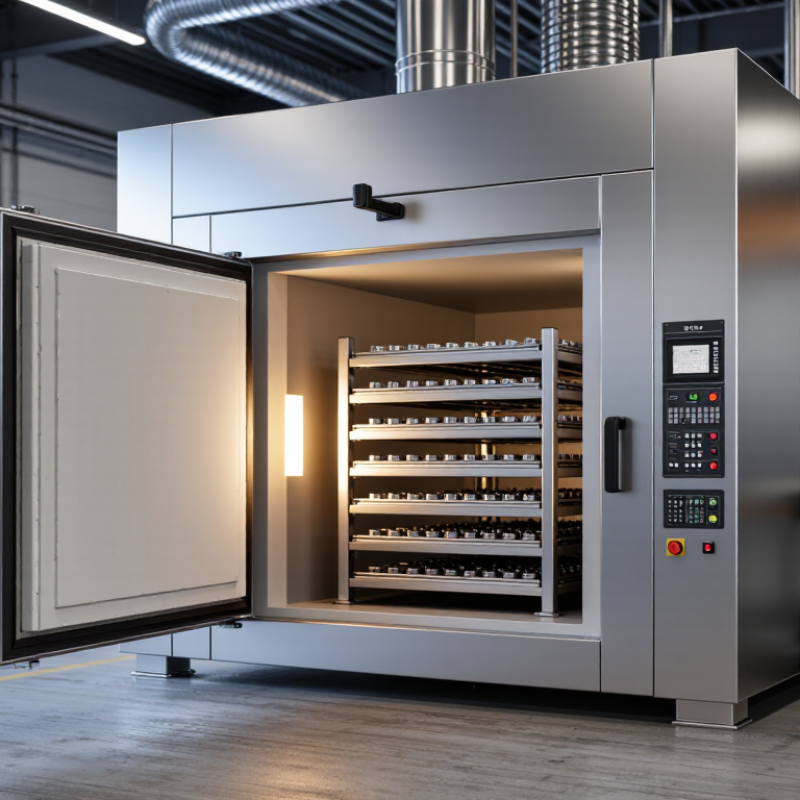
Choosing the right Hardening Oven affects part quality, energy use, production speed, and workplace reliability. The decision deserves more than a catalog comparison. A larger oven may seem safer, but excess volume can increase heat-up time and operating costs. That assumption can fail.
The U.S. Department of Energy’s Industrial Decarbonization Roadmap identifies process heating as a major share of manufacturing energy consumption. This makes insulation, burner efficiency, heat recovery, and standby performance important purchasing factors. The selected oven should match the actual load, not an imagined future order. Measure the largest component, batch weight, tray spacing, and required throughput. Then compare working temperature, temperature uniformity, recovery time, and control accuracy. Small details matter. A cold corner can ruin a batch.
Safety and repeatability require equal attention. NFPA 86 provides recognized guidance for ovens and furnaces, including combustion safeguards, ventilation, and protective controls. Aerospace and other demanding industries may also reference AMS2750 for temperature sensors, uniformity surveys, and calibration practices. These standards do not replace engineering judgment. They support it. Ask suppliers for recent temperature-uniformity test data, sensor specifications, alarm logic, maintenance access, and energy estimates under realistic loading. Do not rely only on brochure ratings. A well-designed Hardening Oven should provide stable results across repeated cycles, with clear records for quality review. The best choice is rarely the cheapest unit. It is the oven that fits your process, operators, facility, and verified production data. Reevaluation is still necessary after installation. Real loads often expose overlooked limitations.
Define Hardening Requirements: Steel Grades, Load Mass, and 800–1,100°C Ranges
How to Choose the Right Hardening Oven?
Define hardening requirements before comparing oven dimensions or heating systems. Identify the steel grade, target hardness, section thickness, and allowable distortion. Carbon steels often harden near 800–900°C, while many alloy and tool steels require approximately 800–1,100°C. The exact temperature belongs to the material specification, not a guess. ASM Handbook, Volume 4A, emphasizes that austenitizing temperature depends on chemistry, geometry, and the required microstructure. A 500 kg load also needs far more heating capacity than a 50 kg basket.
Load mass includes fixtures, trays, and previous scale. Do not calculate only the product weight. NIST guidance on temperature measurement highlights the importance of sensor placement and uniformity during thermal processing. In practice, a furnace showing 900°C on its controller may still have colder corners or a cooler load center. That difference can produce uneven hardness. It is easy to overlook. I have seen production plans fail because the recovery time was ignored. Confirm working-zone uniformity, ramp rate, atmosphere control, and quenching transfer time. Request a temperature-uniformity survey at the intended operating range.
Tips: Build a simple load map. Record steel grade, total mass, part spacing, target temperature, soak time, and quench delay. Test the heaviest realistic load, not an empty chamber. Keep a margin above the required temperature, but avoid excessive heat. It can increase grain growth, scaling, and distortion. ISO 683 heat-treatment specifications and ASM technical data should guide the final cycle. Recheck the cycle after changing batch size.
How to Choose the Right Hardening Oven?
Typical austenitizing temperature ranges for common steel grades. Select an oven that provides stable control across the required 800–1,100°C operating window and has enough usable space for the total load mass.
Temperature ranges are typical industrial starting points and must be verified against the applicable material specification. Larger or denser loads require adequate heating capacity, airflow, and soak time; load mass does not normally change the steel grade’s target austenitizing temperature.
Compare Oven Types by Atmosphere, Capacity, Heating Rate, and ±5°C Uniformity
How to Choose the Right Hardening Oven?
Choosing a hardening oven begins with the material, load, and required atmosphere. A suitable oven should protect parts while delivering repeatable heating results. Atmosphere control matters for oxidation-sensitive steels and precision components. A clean, dry air atmosphere may suit general work. Inert gas or vacuum systems can reduce scaling and surface reactions. Ask for measured oxygen levels, pressure stability, and leak-test records. Do not trust labels alone.
Capacity affects more than the number of parts. A chamber packed with trays can block airflow and create cold zones. Leave space between baskets and walls. Record the load mass, fixture material, and part spacing during trials. Heating rate also changes the process. Fast ramps can shorten cycles, but thick fixtures may heat slowly and unevenly. I have seen empty-chamber tests look excellent while production loads performed poorly. Test the real workload.
The ±5°C uniformity requirement should apply across the usable workspace, not just its center. Request a temperature mapping report using calibrated sensors with traceable records. Check corners, lower shelves, and areas near the door. A stable display reading proves little by itself. Door openings, fan performance, and maintenance can shift results. Ask how often mapping and calibration are performed. Keep records for each production review. One practical caution: uniformity can decline after repairs. Recheck it. This detail is often missed.
Verify Temperature Control Against AMS2750 and Class 2 Uniformity Standards
How to Choose the Right Hardening Oven?
Temperature control should be tested, not assumed from the controller display. A suitable hardening oven must maintain the required setpoint throughout its working zone. Under AMS2750, review the furnace class, instrumentation type, calibration records, and required test intervals. These details affect process confidence.
For Class 2 uniformity, the usual tolerance is ±10°C across the qualified temperature range. Confirm this through a documented temperature uniformity survey, or TUS. Place calibrated thermocouples near corners, the center, and areas close to the load. Record readings after the oven stabilizes. A cold doorway or overloaded rack can reveal problems that an empty test misses.
System accuracy testing also matters. Compare the control sensor with an independent calibrated sensor during operation. Check the results against the applicable AMS2750 requirements and your process specification. Do not accept a certificate without reviewing its temperature range, sensor locations, and test conditions. I would also question a perfect report from an unrealistic empty chamber. Real loads change airflow and recovery time. That is easy to underestimate. A short recovery may look efficient, yet it can create uneven heating between parts. Before purchase, ask for recent TUS data under representative loading. Verify who performed the testing and how the instruments were calibrated. A careful review may take longer, but it exposes weaknesses before production does.
Calculate Energy Use from kW Rating, Cycle Time, Insulation, and Batch Weight
How to Choose the Right Hardening Oven?
Calculate Energy Use from kW Rating, Cycle Time, Insulation, and Batch Weight
A hardening oven’s kW rating shows potential power, not actual energy use. Estimate consumption by multiplying rated kW by operating hours. A 30 kW oven running for two hours could use 60 kWh at full load. Real consumption is usually lower because heating elements cycle on and off. Still, this estimate provides a useful upper boundary.
Cycle time matters more than many buyers expect. Include preheating, ramping, soaking, door opening, and recovery time. A heavy steel batch may extend recovery after loading. For example, a 500 kg load needs more thermal energy than a 100 kg load, especially when parts enter at room temperature. Check the oven’s temperature recovery data, not only its maximum temperature.
Insulation also affects long-term energy use. Thick, well-fitted insulation reduces heat loss through walls, doors, and viewing windows. Inspect door seals during a site visit. Small gaps can create visible hot spots and unstable temperatures. Measure, then compare.
Do not treat the calculation as a guaranteed utility bill. Actual use changes with ambient temperature, loading pattern, controller settings, and maintenance. An oversized oven may waste energy during small batches. An undersized unit may increase cycle delays and reduce throughput. Record kWh, batch weight, and cycle duration during trial runs. Those imperfect measurements often reveal more than a catalogue specification.
How to Choose the Right Hardening Oven? - Calculate Energy Use from kW Rating, Cycle Time, Insulation, and Batch Weight | Oven Configuration | Operating Temperature
°C | Rated Power
kW | Cycle Time
hours | Estimated Heating
Duty Factor | Insulation Thickness
mm | Insulation Condition | Batch Weight
kg | Estimated Energy
per Cycle kWh | Specific Energy
kWh/kg | Energy Cost per Cycle
@ $0.12/kWh | Selection Comment |
| Compact, low-temperature batch oven | 180 | 30 | 1.5 | 0.75 | 100 | Good | 250 | 33.75 | 0.135 | $4.05 | Suitable for small loads and short hardening cycles. |
| Medium batch oven | 220 | 45 | 2.0 | 0.68 | 125 | Good | 400 | 61.20 | 0.153 | $7.34 | Balanced choice for moderate batch sizes and regular production. |
| Production batch oven | 300 | 60 | 2.5 | 0.62 | 150 | Good | 600 | 93.00 | 0.155 | $11.16 | Efficient for medium-to-heavy loads with stable throughput. |
| Large industrial hardening oven | 450 | 90 | 3.0 | 0.58 | 150 | Good | 1,000 | 156.60 | 0.157 | $18.79 | Appropriate when batch weight and chamber volume are high. |
| High-temperature heavy-load oven | 600 | 120 | 4.0 | 0.55 | 175 | Very good | 1,500 | 264.00 | 0.176 | $31.68 | Requires thicker insulation and careful loading to control heat loss. |
| Very-high-temperature production oven | 800 | 180 | 5.0 | 0.50 | 200 | Very good | 2,200 | 450.00 | 0.205 | $54.00 | Best for large, high-temperature batches; verify power availability and ventilation. |
| Calculation method: Estimated energy per cycle = Rated power × Cycle time × Estimated heating duty factor. Specific energy = Estimated energy per cycle ÷ Batch weight. Energy cost = Estimated energy per cycle × electricity rate. The duty factor represents the average proportion of rated power used during a complete cycle, including heating, soaking, temperature control, and typical heat losses. Actual consumption can vary with door-opening frequency, workpiece material, initial load temperature, airflow, exhaust settings, and insulation condition. |